
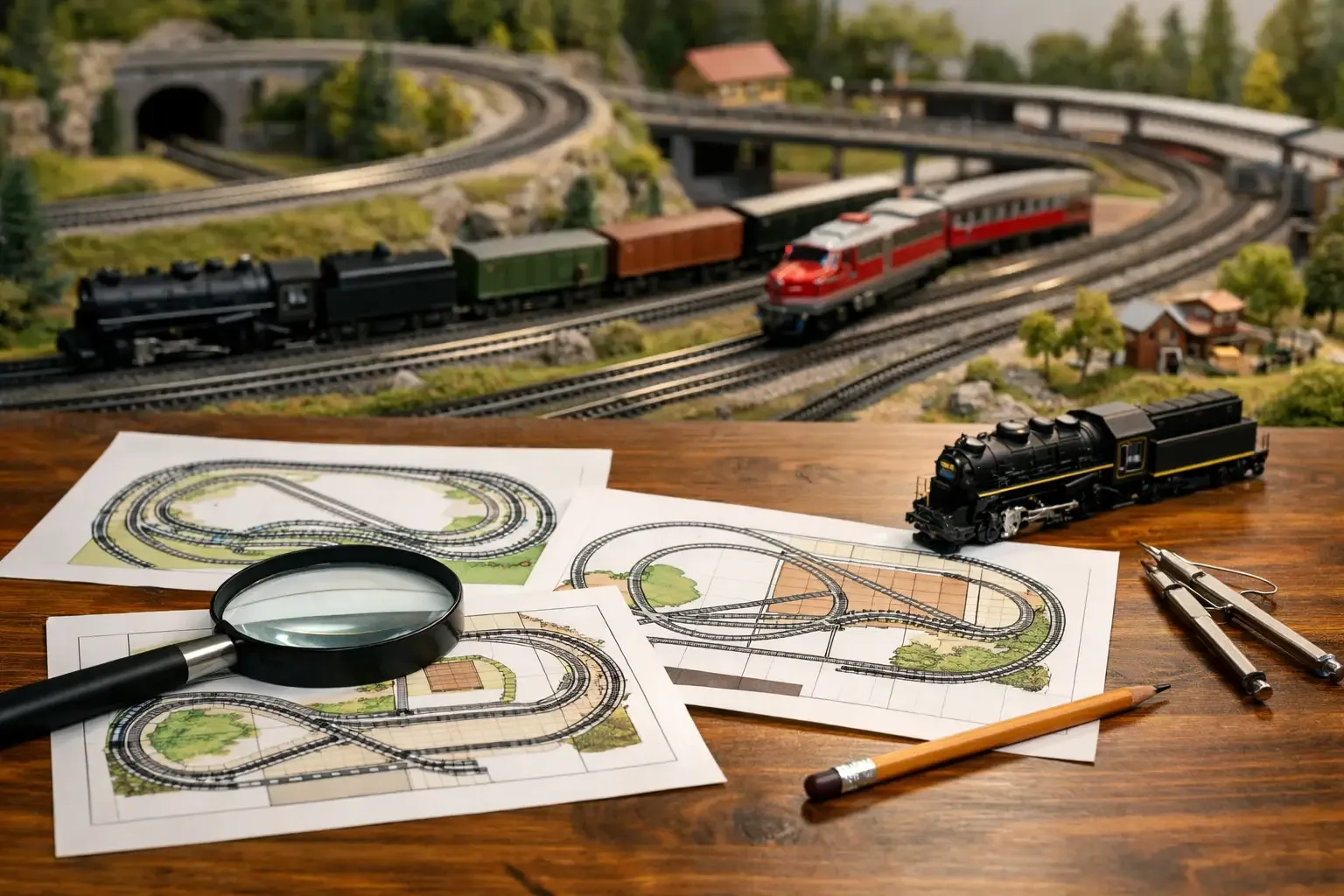
9 HO Scale Track Plan Ideas That Work

A good HO layout usually stops being a track problem after the first sketch and starts being a space problem. That is why the best HO scale track plan ideas are rarely the biggest or the most complex - they are the ones that fit your room, your stock and the way you actually like to run trains.
HO gives you a useful middle ground. You can create convincing scenes, enjoy a broad choice of ready-to-run stock and still fit a satisfying plan into a spare room, loft or garage. The catch is that HO can become cramped surprisingly quickly if you chase too many loops, too many sidings and too much main line drama in one footprint. A smart plan is selective.
What makes HO scale track plan ideas worth building?
The track plan that looks brilliant on paper can be frustrating in real life. Tight reach distances, hidden curves you cannot access and pointwork packed into every corner all have a habit of turning operating sessions into maintenance sessions.
A workable HO plan usually gets four things right. It respects your minimum radius, it keeps turnouts where you can reach them, it gives trains a reason to move, and it leaves enough open space for scenery to breathe. If you like watching long passenger trains roll, your plan should favour flowing curves and a visible run. If you prefer shunting, a compact industrial design may give you far more enjoyment than a double-track oval.
That sounds obvious, but many builders still begin with the fantasy layout rather than the realistic one. There is no shame in choosing a simpler plan that runs well from day one.
9 HO scale track plan ideas for real layouts
1. The classic oval with purpose
This is the starting point many people dismiss too quickly. A plain oval is basic. An oval with a passing loop, two sidings and a scenic divider is a proper layout.
One side can become a station scene, the other an industrial district or small yard. Add a low-relief town backdrop or a row of warehouses to break the visual loop. The result is continuous running when you want it and enough operating interest when you want to do more than watch trains circle.
This works especially well for newer builders or anyone returning to the hobby after years away. It is forgiving, expandable and far less dull than its reputation suggests.
2. The folded dogbone
If you want the impression of distance without a very large room, a folded dogboneis hard to beat. The train appears to travel from one scene to another, often with the turnback curves hidden in hills, urban blocks or staging.
The strength of this plan is visual separation. You can model two quite different locations on one railway and make the run between them feel longer than it is. The trade-off is that turnback loops still need space, so this idea suits a medium room better than a narrow shelf.
3. The around-the-walls branch line
For many experienced HO builders, this is where things become interesting. Around-the-walls benchwork gives you longer runs, broader curves and better use of floor space than a large central board.
A branch line plan is particularly effective because it does not need a huge yard or four-track main line to feel believable. A terminus, a few intermediate stops and a freight customer or two can keep a session busy. You also gain generous scenery depth in selected areas while keeping the track itself within comfortable reach.
If your room allows a central operating well, this style often delivers more railway for less compromise.
4. The shunting-first industrial layout
Not every HO railway needs a continuous loop. If your enjoyment comes from uncoupling, placing wagons and planning moves, an industrial switching layout can offer far more variety in less space.
Think warehouses, a fuel dealer, team track, small engine facility or urban goods yard. The track can be relatively simple but operationally rich. A run-round loop, a few facing and trailing point challenges and limited siding lengths create genuine decision-making.
This approach suits a shelf beautifully. It also rewards careful scenic work because industrial settings thrive on close-up detail.
5. The station-to-fiddle yard plan
This idea is ideal for modellers who enjoy a believable scene rather than visible looping. One end of the layout is the scenic focus - perhaps a country station, town terminus or junction - while the other end disappears into staging or a fiddle yard.
The beauty here is realism. Trains arrive from somewhere, do their work, then leave. You are not trying to disguise the same train passing the same church every thirty seconds. For exhibition-style operation or disciplined home running, it is a strong choice.
The compromise is obvious: no continuous running unless you add a hidden return loop or separate circuit. For some builders that is a non-issue. For others, it becomes a regret later, so be honest about how you like to operate.
6. The small town junction
A junction instantly gives a layout a reason to exist. Even in a modest footprint, one line can continue as the main route while another serves a branch or industrial district. You create traffic variety without needing a giant empire.
This type of plan works well if you own a mixed fleet. Local passenger trains, through freights, branch goods and light engine moves all make sense at a junction. Visually, it also helps scenes feel busy without simply adding more parallel track.
Keep the temptation to overcomplicate under control. One clean junction with a goods siding is often stronger than a web of crossovers that adds maintenance but little operating value.
7. The hidden staging main line
If you like the theatre of trains appearing and disappearing, hidden staging deserves serious thought. A visible main line scene with off-stage storage can make even a moderate HO layout feel part of a larger railway system.
You might have a scenic station, bridge and freight spur on the visible level while trains queue in hidden sidings below or behind a backdrop. This is particularly effective for modern image running, where complete trains can enter, pause and depart without much yard activity.
The warning is simple: hidden track must be reliable and reachable. If access is poor, the magic wears off fast. Build fewer staging roads if that is what it takes to maintain them properly.
8. The out-and-back mountain route
For builders who love scenery as much as operation, an out-and-back design can be deeply satisfying. The line climbs, curves and crosses itself, often using elevation to make a compact space feel dramatic.
This is one of the best HO scale track plan ideas for anyone inspired by mountain railways, logging lines or scenic American routes. Bridges, tunnels and retaining walls become part of the story rather than decorative extras.
Still, gradients need discipline. In HO, an ambitious climb with sharp curves can quickly expose the limits of locomotive performance. Test early, especially if you want longer trains.
9. The urban terminal layout
A city terminus or commuter-focused plan gives you action in a concentrated footprint. Platforms, carriage sidings, parcels traffic and nearby industry all sit naturally in a compact scene.
This works especially well for modellers drawn to passenger stock, station architecture and dense scenery. You do not need miles of track when the visual centre is the terminal itself. A hidden approach or cassette system can supply arriving trains.
The challenge is selective compression. Real urban terminals are huge. The model version must capture the atmosphere without turning into a tangle of impossible pointwork.
How to choose the right plan for your space
Start with train length, not track pieces. If your typical freight is eight wagons and a locomotive, or your passenger train is six coaches, your loops, sidings and platforms need to suit that. Too many layouts fail because the owner drew a plan first and discovered later that nothing fits gracefully.
Then think about reach. In most home settings, a depth of around 60cm to 75cm is comfortable for detailed HO work, though corners and hidden track complicate things. If you have to lean across buildings and overhead wires to rerail stock, the design is asking for trouble.
Also decide what kind of session you want on a Tuesday evening. Ten minutes of continuous running after work needs a different plan from a two-hour operating sequence with waybills and a timetable. Neither is better. They are simply different hobbies inside the same hobby.
Common mistakes with HO plans
The biggest one is trying to include every good idea at once. A yard, engine depot, branch terminus, harbour scene, mountain pass and city station may all be attractive, but packed together they usually make each other weaker.
Another common error is underestimating curve radius. HO can look excellent, but longer coaches and bogie wagons still need room to look their best. If appearance matters to you, broader curves often improve a layout more than adding another siding.
Finally, leave room for the scene. Track plans are not the layout. Streets, embankments, retaining walls, back gardens, loading docks and open countryside are what make trains look as though they belong there. If every inch is rail, the whole thing can feel toy-like no matter how carefully it is wired.
The most satisfying layouts are usually the ones with a clear idea behind them. Pick a track plan that suits your room, your stock and your habits, then let the railway breathe. If you build for the way you truly enjoy the hobby, the rest tends to follow.
Related Posts
Comments (0)
Community Guidelines
Keep all comments friendly. Feedback should be constructive and no derogatory comments are tolerated.
Sign in to join the conversation
No comments yet
Be the first to share your thoughts!