
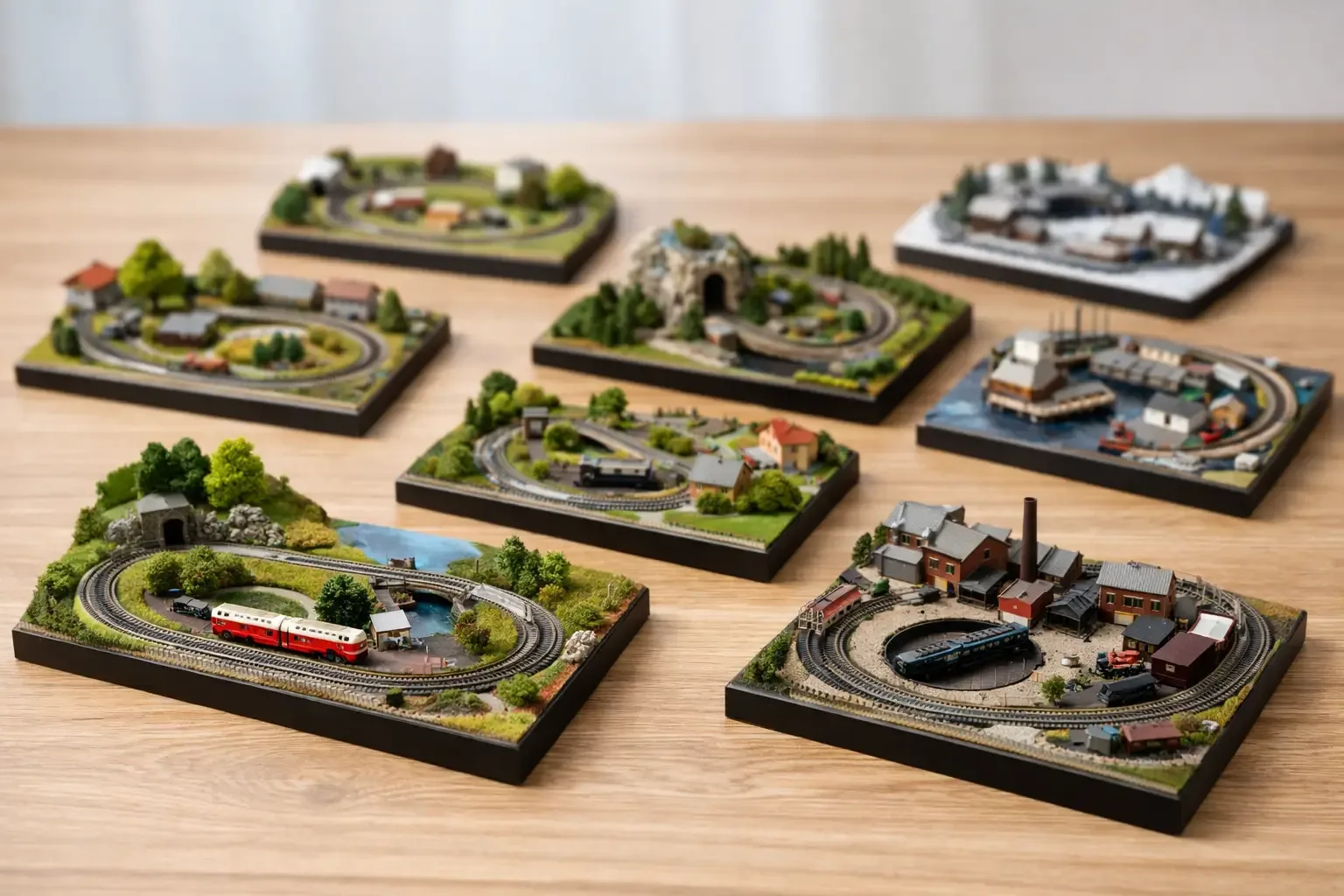
9 Small N Gauge Layout Plans That Work

The usual problem is not ambition - it is the spare room, the shelf in the study, or the bit of loft floor you can actually claim as your own. That is why small N gauge layout plans are so popular. N gives you just enough room to suggest a proper railway, not merely a train running in circles, and with careful planning a compact layout can feel busy, believable and deeply satisfying.
Small plans work best when they are designed around a clear purpose. If you try to squeeze in a main line, a branch terminus, a goods yard, a depot and dramatic mountain scenery on a board barely larger than a coffee table, the whole thing usually ends up cramped. The strongest compact N gauge layouts choose one idea and do it well.
What makes small N gauge layout plans successful?
The first thing is restraint. In a small space, every turnout, platform and structure has to earn its place. A compact plan is not just a bigger layout shrunk down. It needs broader scenic suggestions, simpler track geometry and a realistic sense of how trains will actually operate.
The second is reach. Many builders sketch a plan that looks brilliant on paper, then realise the back siding is impossible to rerail or clean. On a small board, access matters as much as appearance. If you cannot comfortably reach every inch, the layout will become frustrating far sooner than it becomes finished.
The third is curve discipline. N gauge can handle tighter curves than larger scales, but there is still a trade-off. Very sharp curves save space, yet they can look toy-like and restrict the stock you can run. If your heart is set on long bogie coaches or modern diesels, your minimum radius needs more thought than if you mainly run short branch line stock.
1. The classic oval with a purpose
The simplest of all small N gauge layout plans is an oval, but the version worth building includes more than continuous running. Add a passing loop, one siding and a small station, and suddenly you have options. One train can circle while another waits in the loop, a parcels van can be shunted, and a station scene has a reason to exist.
This plan suits beginners because it is forgiving. It also suits experienced modellers who want a layout that is always ready for a quick operating session. The risk is obvious - if the oval dominates the board with no scenic separation, it can look flat and repetitive. A low road bridge, embankment or stand of trees can do a lot to break that visual loop.
2. The inglenook or micro shunting plank
If your space is truly tight, a shunting plank may be the smartest answer. A board around shelf depth can still hold a headshunt and a few sidings, enough for wagon sorting, goods traffic and point-to-point movement. In N gauge, that small footprint can still feel generous.
This kind of plan rewards careful operation rather than speed. You are not watching expresses thunder past. You are building short trains, placing wagons accurately and enjoying the details. For many modellers, that is the appeal. For others, especially those who want to watch trains roll continuously, it may feel too static.
3. The branch terminus on a shelf
A branch terminus is one of the best uses of N in a narrow room. The station sits at one end, with a run-round loop, a goods siding and perhaps a small engine facility. The line disappears behind a backscene or into a fiddle yard, giving the impression that the railway continues well beyond the visible scene.
This is where compact layouts start to feel far bigger than they are. Instead of trying to show the entire railway, you show one convincing slice of it. Passenger trains arrive, the loco runs round, vans are left in the dock siding and the branch comes alive.
The trick is not overloading the terminus. Too many sidings can leave no space for buildings, roads or atmosphere. A country branch station with modest track often looks more convincing than a tiny board packed with pointwork.
4. The folded dogbone for longer runs
Some small N gauge layout plans are all about making the run feel longer. A folded dogbone uses loops at each end with a central scenic section between them. Because the train curves away and returns, it creates the sense of distance better than a plain oval.
This is a strong choice if you enjoy watching complete trains move through scenery. It can work especially well on a board that is longer than it is deep. The challenge is disguising the return curves. If both ends are fully visible, the illusion weakens. Tunnels, urban overbridges or hidden sections can help, but they need to be done with care so maintenance does not become awkward.
5. The continuous run with hidden sidings
A lot of builders want the best of both worlds - simple running when friends are over, and some operating interest when working alone. A compact continuous run with hidden sidings delivers that rather well. The visible section might be a station or a stretch of main line, while a hidden loop or sector plate stores extra trains.
This plan is excellent for variety. One train disappears and another emerges, which gives a small scene more life. The downside is complexity. Hidden track must be reliable, accessible and easy to inspect. In a compact layout, hidden sections that are hard to reach can turn a clever idea into a regular annoyance.
6. The corner layout
Corners are often wasted space, yet they can be perfect for N gauge. A corner plan can use each wall for scenic runs, with the curve tucked into the corner itself. That opens up interesting possibilities: a junction station on one side, an industrial scene on the other, or a rural branch turning out of sight.
Corner layouts feel larger because the railway travels somewhere rather than simply sitting on a rectangular board. They also offer natural viewing angles. The main limitation is baseboard design. You need to think carefully about board joints, support and access into the corner, especially if the layout sits above furniture.
7. The industrial end-to-end plan
Industrial scenes are ideal for compact N gauge because tight curves and dense track can look perfectly at home. A dock branch, quarry line, warehouse district or small factory complex gives wagons a reason to move and buildings a reason to crowd the scene.
This approach can be wonderfully characterful. It suits modellers who enjoy weathering, structure building and varied wagon traffic. It may be less appealing if your interest leans towards long passenger trains and sweeping countryside. As ever, the best plan is the one that suits the trains you actually want to run.
8. The scenic cameo with a cassette fiddle yard
Sometimes the answer is not more layout, but less visible layout. A scenic cameo paired with a cassette fiddle yard lets you focus your effort on one polished scene. Trains enter, pause, shunt or pass through, then leave the stage. Off-scene, cassettes allow stock changes without consuming precious board space.
This is a particularly smart route for exhibition-style presentation at home. It keeps the scene tidy and concentrated. The trade-off is manual handling. If you dislike swapping cassettes or lifting stock, it may not suit your way of operating.
9. The layered plan for vertical interest
On a small board, vertical variation can add more impact than extra track. A plan with one line climbing above another, or a station overlooked by a retaining wall and road bridge, creates depth and drama. In N gauge, modest height differences can look substantial.
There is a caution here. Gradients need careful calculation, and too much rise in too little distance will limit train lengths. Layering works best when it serves the scene rather than trying to prove how much engineering can be crammed into a tiny footprint.
How to choose between small N gauge layout plans
Start with operation, not track. Ask what a satisfying ten-minute session looks like to you. If it is watching a train circle while you admire scenery, choose a continuous run. If it is assembling a goods train from scattered wagons, choose a shunting or branch layout. If it is seeing different trains appear one after another, build in hidden storage.
Then match the plan to the stock you own or genuinely intend to buy. Compact track plans and long modern coaching stock often pull in opposite directions. There is nothing wrong with that, but it helps to be honest early on.
Scenery should come next. A small N gauge layout becomes memorable when the scene feels coherent. Rural branch, suburban terminus, industrial edge, dockside freight - each asks for different spacing, structures and track density. The plan should support the story, not fight it.
Common mistakes in compact N gauge planning
The most common mistake is adding one more turnout because there seems to be room. Track planning software and paper sketches can be deceptive. What fits geometrically may still feel crowded once platforms, signals and buildings appear.
Another mistake is underestimating clearance. N gauge is compact, but fingers are not. Leave enough room around structures, tunnel mouths and platform edges for maintenance and handling. That extra centimetre often matters more than the extra siding.
Finally, avoid treating hidden track as an afterthought. On a small layout, reliability is everything. A simple visible plan that runs flawlessly will always beat a clever plan that constantly derails.
The best small layout is not the one that includes the most. It is the one that gives you a reason to keep returning to the workbench, the controller and the scene itself. Share, refine and learn from what other builders are doing - because in a hobby full of grand loft empires, a compact N gauge plan that works brilliantly is always worth admiring.
Related Posts
Comments (0)
Community Guidelines
Keep all comments friendly. Feedback should be constructive and no derogatory comments are tolerated.
Sign in to join the conversation
No comments yet
Be the first to share your thoughts!